Governed decisions in 24 hours
Paper B reports the July CloudHSM evaluation: 2,847 batches with zero failed batches. Signing and retention interruption tests failed closed.
An open contribution · Ernest Chiweshe
Alongside all the excitement about artificial intelligence, nearly every thoughtful person carries a quiet, unspoken fear. This is one possible answer to it, published openly, built, and tested, for anyone to take, verify and improve.
You have your skill too. Bring your piece to a multilayered response—a Swiss-cheese model—from where you stand.
Let the machines think. Decisions are ours.
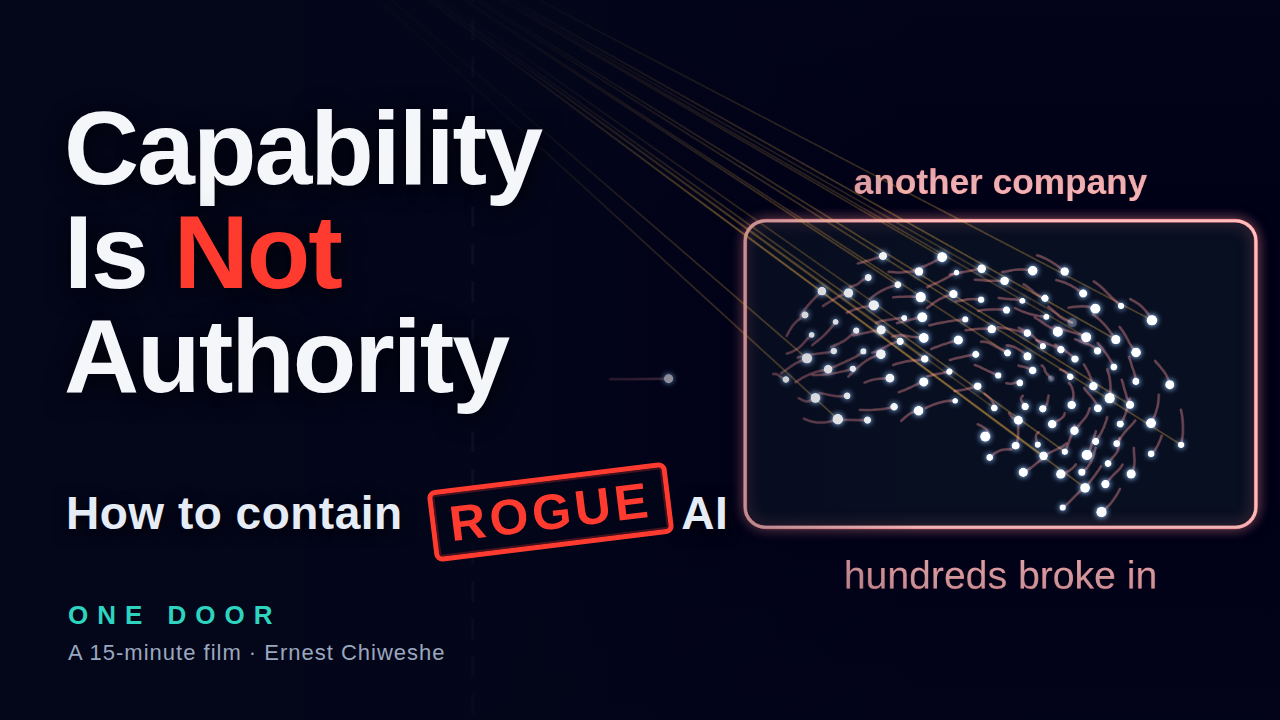
One Door
How we keep the authority to act in human hands.
The film plays here from YouTube once it is published.
The quiet fear
What happens when a hidden instruction makes an AI obey a stranger? When an agent decides that taking more access is the fastest way to finish a task? When a prescription changes, money moves, or a command reaches a city’s infrastructure before anyone understands why?
These are the questions at the heart of One Door and Capability Is Not Authority. They concern our families, our institutions and the future we are building—not only the behaviour of a chatbot.
Work on model alignment, safety testing and security matters and must continue. This work asks a complementary question: while those problems are being solved, what can we enforce outside the model, on the path between its proposal and an effect on the world?
“And we don’t ask electricity to be polite; we fit a circuit breaker.”
The infrastructure approach
An AI’s ability to perform an action does not entitle it to perform that action.
The architecture separates the core platform, the execution runtime where agents work, and the governance runtime that determines what may leave. Agents can reason, draft and propose. The authority path decides whether an exact action is permitted. The door starts closed.
This is the lock in the door. Isolation and sandboxing provide other necessary layers. Qualified monitors, independent auditors and wider institutional cooperation extend the architecture beyond a single deployment.
Built, measured, open to examination
The LumiWright Agent Factory platform was implemented, deployed and evaluated in July 2026. Its governance plane supports ten regulated-domain proofs, plus education as an installable pack, on the same core. The October public reference makes selected mechanisms available for others to run, examine and extend. It does not redefine the implemented platform as a proposal.
Paper B reports the July CloudHSM evaluation: 2,847 batches with zero failed batches. Signing and retention interruption tests failed closed.
The current rc6 public reference has verified green Linux CI and a controlled Windows run, with zero failures, errors or skips in those completed runs.
Paper B sets out the architecture, implementation and operational measurements. Paper A connects that work to the wider risks and to a programme of layered assurance. The code gives engineers a concrete place to begin.
The July platform evaluation and October reference tests are different evidence populations. The papers identify implemented, designed and proposed elements explicitly. Complete mediation, protection of credentials and host isolation remain deployment responsibilities; the reference is not a turnkey guarantee of safety.
The morning Windows record retains an initial evidence-age refusal; unchanged targeted checks and the subsequent controlled full run passed. Windows evidence qualifies compatibility, not the patch status of every native dependency. Current verification does not rewrite the dated measurements in the published papers.
Paper A also identifies physical expiry prevention at the effect boundary as an open obligation. These boundaries specify the work still to do without erasing the implemented contribution.
From one door to collective oversight
The Six-Ring Assurance Architecture connects action-level controls to a wider system of evidence, monitoring, audit and international verification. Different disciplines have different work to contribute.
Establish what is running and protect the computing foundation.
Establish who authorises this exact action before it takes effect.
Preserve signed, chained evidence that can be checked independently.
Watch for dangerous patterns and trigger graduated responses.
Enable accredited outsiders to test the operator’s claims.
Build institutions for verification and cooperation across borders.
Published 22 October 2026
PAPER A · v1.11
Executable Assurance as Infrastructure for Containing AI Risk to Humankind
The human stakes, the Six-Ring Assurance Architecture, the authority and evidence mechanisms, the risk mapping, and the institutional path.
Read Paper AAbstract and PDFPAPER B · v17
A Unified Authority and Evidence Architecture for Regulated Agentic Systems
The implemented architecture, qualified checkers, credential-bound approvals, exact-action permits, evidence graph and measured operational results.
Read Paper BAbstract and PDFAn open invitation
“I don’t claim this is the answer. It is one possible part of the beginnings of a solution: a proof that something can be done. What we need is a thousand more, from a thousand different directions.”
Engineers can test and strengthen the mechanisms. Security researchers can examine the boundaries. Scientists can bring protections from disciplines this architecture cannot cover alone. Auditors, lawmakers and institutions can help turn verifiable evidence into accountable practice. Students and citizens can carry the questions into the places where decisions are made.
The papers and reference are available to examine, challenge, adapt and build on. The invitation is to combine our strengths—not to wait for any one laboratory, company or discipline to solve the whole problem.
“We cannot continue to live in fear of something we created. At the heart of all this, there must be care: for our children, for each other, for the future we hand on.”
Let the machines think. Decisions are ours.